
Kenya is moving forward with the Refugee Act 2021 and the Shirika Plan, both of which promote a more integrated and long-term approach to refugee hosting. As a result, the municipality Kakuma is playing an increasingly important role in delivering inclusive, practical and sustainable urban services.
Solid waste management (SWM) is a practical area where municipalities can make a visible difference. Better systems can improve public health and service delivery, while also strengthening local government capacity and performance. They can also create economic opportunities, especially for young people, through recycling and other circular economy activities.
VNG International’s signature approach
We deliver municipality-led, financially sustainable SWM systems by:
- Developing municipal by-laws & governance frameworks.
- Designing of end-to-end SWM value chain (segregation → collection → recycling → disposal).
- Promoting waste as a resource (circular economy, recycling, composting).
- Strengthening financial sustainability (support to leverage waste revenue streams).
- Facilitating of inclusive systems (host-refugee integration, informal sector inclusion).
Outcome: Systems that municipalities can own, finance and sustain.
To learn more about VNG International’s approach to waste management, check out our brochure:
VNG International’s approach to solid waste management (pdf)
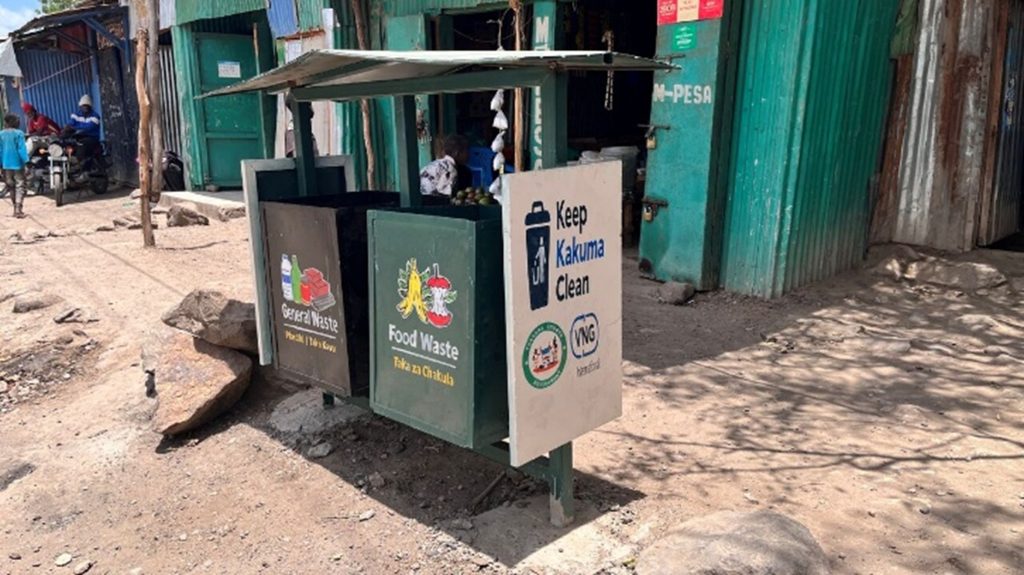
Kakuma Demonstration (Ongoing)
We are implementing a Solid Waste Management demonstration project in Kakuma Municipality. We combine practical service improvements with stronger local governance and community participation.
This includes:
- Pilot source segregation and structured collection systems within refugee camps and host communities.
- Provision of basic waste infrastructure (bins).
- Community waste management committees (host & refugee inclusion).
- Strengthened municipal coordination and ownership.
Result: An inclusive municipality-led SWM model in a complex context.
Scaling opportunity: enhance and replicate
The Kakuma model can now be scaled and strengthened through:
- Municipal capacity building on waste as a resource, by-laws, and financial systems.
- Infrastructure development (recycling centres, composting sites, transfer stations).
- Value chain expansion (youth enterprises, private sector engagement, market linkages).
Global expertise and added value
VNG International brings proven experience in complex and refugee-hosting contexts:
- Institutional reform in Sint Maarten: Design and establishment of a new Waste Authority in Sint Maarten with World Bank. (Video)
- Refugee contexts in Jordan: Improved SWM in North Jordan. Focus on refugee camps of Za´Atari, Azraq and municipalities with UNHCR and UNICEF. (brochure, pdf)
- Waste management and circular economy in Colombia: Integration of informal waste actors (video and brochure (pdf))
- Circular economy and bankable waste projects in Uganda: Nexus and IDEAL
Strategic opportunity for Kenya’s State Department for Housing and Urban Development
- Leverage VNG International’s expertise in Integrated Solid Waste Management (ISWM) to provide technical support across policy, system design, infrastructure planning, and implementation.
- Develop and operationalize SWM guidelines and municipal by-laws, grounded in international best practices and tailored to Kenya’s urban and refugee-hosting contexts.
- Strengthen SWM value chains and municipal performance systems, advancing waste as a resource and improving service delivery efficiency.
- Scale the Kakuma SWM model to Dadaab Municipality and other KUSP municipalities.
Replication in Dadaab Municipality offers a natural next step under the Kenya Urban Support Program (KUSP).
As the International Cooperation Agency of the Association of Netherlands Municipalities and as a peer to local governments, we bring a wealth of experience in:
- Circular economy: We support governments and municipalities in transitioning to circular waste management models, promoting waste reduction, recycling, and the reuse of materials from reform, policy and strategy development to practical implementation.
- Waste collection and recycling: We help design and implement efficient waste collection systems, including sorting and recycling programs, to maximize resource recovery.
- Policy and strategy development: supporting with policies, strategies, and plans that align with international good practices and local needs, strengthening regulatory frameworks.
- Behaviour change: We foster public awareness campaigns and community engagement to encourage sustainable waste practices at the household and community level.
- Inclusivity: Our projects ensure that marginalized groups, such as informal waste pickers and women and youth, are integrated into waste management frameworks, promoting social inclusion, ensuring inclusive service delivery and creating employment opportunities.