
DEALS, Governance of Inclusive Green Growth in Cities
Governance of Inclusive Green Growth in Cities (DEALS) was a five-year programme (2017-2022) that supported six rapidly growing cities in Africa, Asia and Latin America in tackling urban challenges through local governance and cooperation.
Explore the interactive DEALS report to discover the results and lessons learned
About the programme
Cities around the world are facing increasingly interconnected challenges. Climate change, environmental degradation, rapid urbanisation, inequality, migration and pressure on public services all affect the daily lives of residents. Addressing these challenges requires more than technical solutions alone. It requires local governments that are able to work inclusively, across sectors and together with citizens, businesses and civil society.
The DEALS programme supported municipalities in six cities across Africa, Asia and Latin America: Beira (Mozambique), Kumasi (Ghana), Manila Bay municipalities (the Philippines), Pathein (Myanmar), Pereira (Colombia) and Sèmè-Kpodji (Benin).
The programme focused on strengthening local governance for more inclusive, resilient and sustainable urban development. Inspired by the Dutch City Deals approach, DEALS brought together local governments, national authorities, private sector actors, knowledge institutions and community organisations to jointly tackle complex urban challenges. It contributed to Sustainable Development Goal 11, making cities inclusive, safe, resilient and sustainable, and Sustainable Development Goal 16, promoting effective, accountable and inclusive institutions.
Our approach
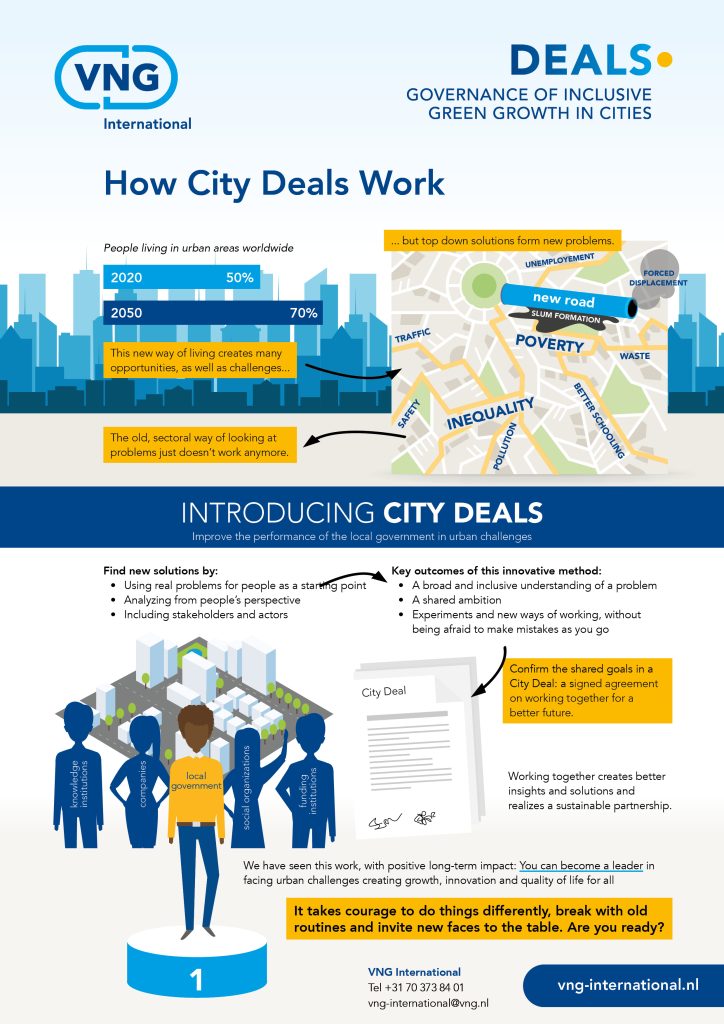
The starting point of DEALS was that urban challenges are interconnected. Flooding affects public health and economic activity. Waste management influences environmental quality, public space and social inclusion. Urban congestion impacts mobility, livelihoods and climate resilience. Addressing one issue in isolation can unintentionally create problems elsewhere.
For that reason, DEALS promoted an integrated governance approach. The programme supported municipalities in strengthening cooperation between departments, levels of government and external stakeholders. It also encouraged experimentation, learning and adaptation throughout implementation.
In each city, the programme focused on developing governance capacity through integrated, multi-level, multi-stakeholder and inclusive approaches. Particular attention was given to informality, participation, gender inclusion and long-term sustainability.
The programme also developed practical learning tools to make integrated governance more tangible and measurable. These included a questionnaire and measurement framework based on six key elements of integrated governance, factsheets for partner cities (see below, at ‘More information’) and a background paper supporting comparative learning across countries.
More on our approach
- See our infographic
- Animation video about the integrated governance approach
- Video of mayors from Kumasi, Pereira and Sèmè-Podji who share their perspectives on integrated approaches to complex urban challenges
- Video of civil servants from Kumasi, Pereira and Sèmè-Podji who reflect on integrated urban governance in practice
- Video of VNG International experts explaining integrated approaches to urban challenges in Kumasi, Pereira and Pathein
Local results and impact
Beira, Mozambique
In Beira, the programme focused on land administration and climate-resilient urban development. The municipality indexed and digitalised its cadastre system, reaching 34,886 documents. Property tax revenues increased following the revaluation of 800 properties and public awareness campaigns. Sustainable compensation revenues also increased by 45%.
The programme supported more climate-resilient urban planning and land management as steps towards more formalised urban development. In addition, 150 machambeiras graduated from skills training under the Young Africa Programme.
Kumasi, Ghana
In Kumasi, DEALS supported cooperation around urban congestion, slum development and circular economy initiatives. Interdepartmental cooperation became structurally embedded within the project team, while stakeholders committed themselves to decongestion initiatives. The Circular Economy Hub was completed and 70 participants joined Public-Private Partnership training programmes.
The programme also supported large-scale data collection on market functions, living conditions and service provision in pilot areas. A multi-level governance conference on congestion in Kumasi was organised, alongside preparatory work for a Bus Rapid Transport system. Additional activities included feasibility studies for parking and satellite market development, the design of four prototype bridges for slum areas using waste materials and training and registration support for informal businesses.
Manila Bay region, the Philippines
In the Manila Bay region, DEALS supported cooperation between local governments around waste and water management within the broader Manila Bay Sustainable Development Master Plan. The programme increased political commitment to interlocal cooperation and strengthened the involvement of mayors and municipal staff in the master planning process. Tailor-made mapping exercises helped identify intergovernmental convergence opportunities.
Technical assistance contributed to waste management data systems, including data visualisation mapping for Bataan and Cavite provinces. The programme also resulted in a business case and feasibility study for a composting facility to manage green household waste.
Pathein, Myanmar
In Pathein, the programme supported neighbourhood-level cooperation around flooding prevention, waste management and recycling. DEALS helped create an environment for interdepartmental, intergovernmental and multi-stakeholder cooperation that was considered unique in the local context. Awareness among government staff, civil society organisations and community groups on waste reduction and management increased significantly.
Concrete interventions included the construction of 14 drainage lanes, participatory budgeting and planning training sessions, flood prevention works in Ward 12 and neighbourhood clean-up campaigns in Wards 1 and 2. A plastic reduction incentive campaign reduced the use of 22,000 plastic bags within six weeks, while shopkeepers and residents participated in awareness activities on waste management.
Pereira, Colombia
In Pereira, the programme focused strongly on circular economy and the inclusion of informal waste pickers. An agreement between stakeholders led to the launch of a circular economy laboratory and strengthened cooperation between the municipality, private sector actors and recycling organisations. A partnership investment was established with the private sector foundation CEMPRE.
The programme supported the formalisation process of informal waste recyclers through route georeferencing maps, support to Recycling Tax Fund projects and census activities for waste pickers associated with recycling organisations. Additional activities included circular economy training courses, neighbourhood and school recycling competitions, a municipal waste management website and a study visit to Medellín for municipal officials. As part of the programme, 291 waste pickers received official identification cards.
Sèmè-Kpodji, Benin
In Sèmè-Kpodji, the programme addressed urbanisation, environmental management, waste management and flood prevention.The programme established a unique multi-departmental focal team and strengthened cooperation between public and private stakeholders. Relevant by-laws were adopted and new cooperation agreements with private sector partners were concluded to support more sustainable and inclusive environmental management in the Agblangandan arrondissement.
Learning, adaptation and programme development
The programme began with an inception phase between September 2017 and February 2018. During this period, extensive analytical work was carried out to inform programme design and implementation.
This included:
- urban development analyses;
- urban sustainability analyses;
- Political Economy Analyses;
- inclusiveness analyses focused on gender and informality;
- organisational capacity analyses;
- baseline studies;
- theories of change;
- annual action plans;
- communication and visibility plans;
- monitoring and learning plans.
A key principle throughout the programme was adaptive implementation. DEALS encouraged municipalities and partners to learn from practice, adjust approaches where necessary and share lessons across countries and cities.
Monitoring and evaluation
Mid-term evaluations were conducted across the programme to assess progress, identify challenges and strengthen implementation. The programme published:
- Mid-term review report for Manila and Beira.
- Synthesis Report covering Kumasi, Pathein Pereira and Seme-Podji
- Response tables outlining VNG International’s response to reviewer observations and recommendations
More information
Watch the explainer video about the DEALS programme
Take a look at the fact sheets (in pdf) per city:
- Mozambique : Factsheet-Beira
- Ghana: Factsheet-Kumasi
- Philippines: Factsheet-Manila
- Myanmar: Factsheet-Pathein / Factsheet-Pathein Myanmar language
- Colombia: Factsheet-Pereira
- Benin: Factsheet-Sèmè-Podji
Listen to the Voice of DEALS
In a series of podcasts we interviewed people involved in the DEALS programme.